

Modal center
Treat the first chord as home when practicing aeolian mode on guitar. Return to it often so the mode does not collapse into ordinary major or minor harmony.
Guitar modes
Explore aeolian mode on guitar with guitar-focused examples, voicing notes, practice suggestions, songwriting angles, and direct StrumForge generator links.
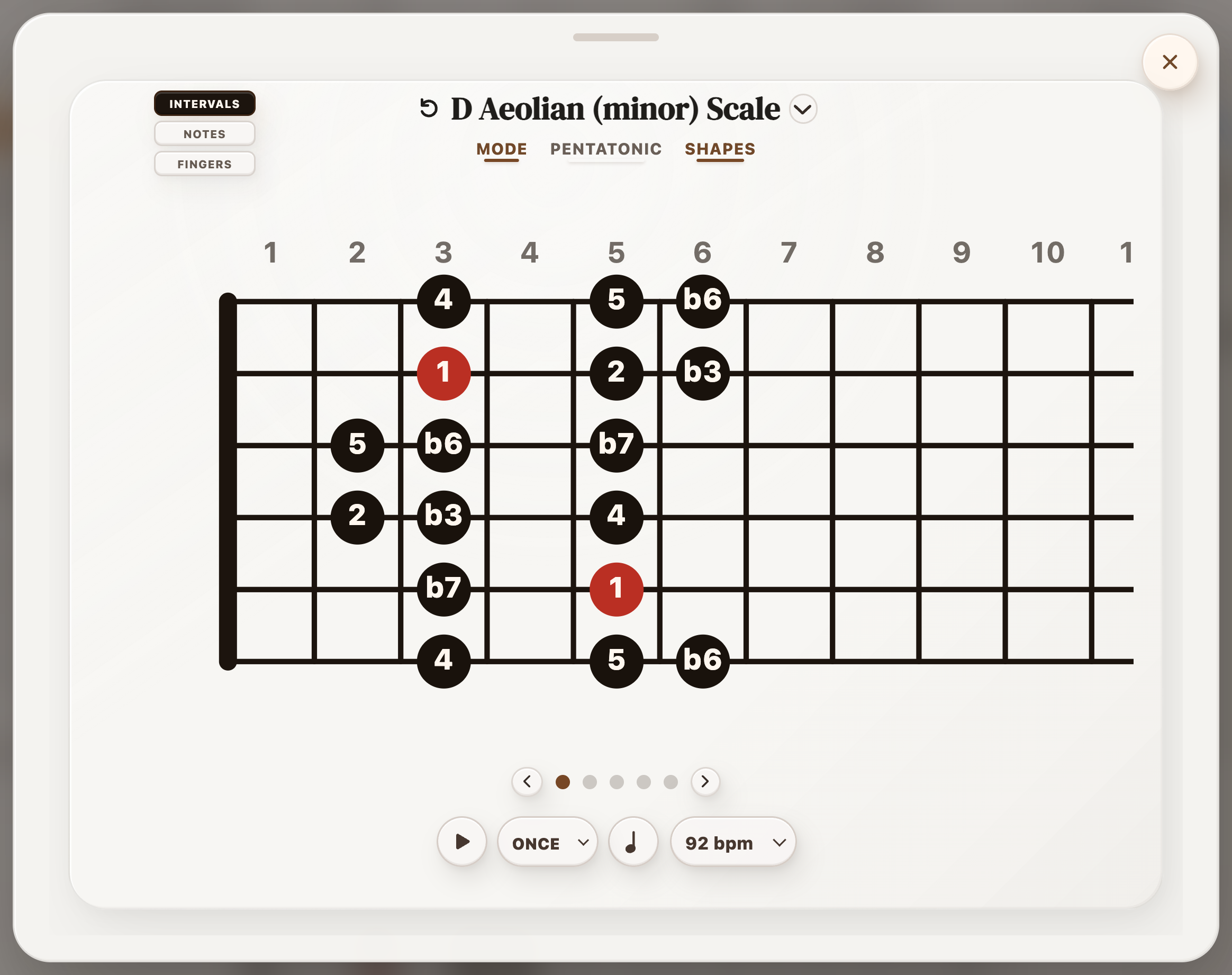
Each loop uses natural minor movement with flat VI and flat VII color.
Keep the tonal center obvious, then listen for the note or chord that creates the modal color.
Treat the first chord as home when practicing aeolian mode on guitar. Return to it often so the mode does not collapse into ordinary major or minor harmony.
Aeolian is the natural minor sound. Flat VI and flat VII chords give it motion without using the stronger harmonic-minor dominant.
Use drones, repeated bass notes, and compact triads to make the modal center clear. Busy cadences can hide the sound you are trying to practice.
Build short phrases around chord tones first, then land on the mode color note deliberately so the scale shape becomes musical.
| When you need... | What to do on guitar |
|---|---|
| To understand the sound | Listen for the chord movement or scale degree that makes aeolian mode on guitar different from the plain major or minor version. |
| To make it playable | Try the idea with small triads or seventh-chord shapes before using full six-string grips. |
| To use it in a progression | Loop the chord before the change, the color chord, and the chord after it until the pull or surprise is easy to hear. |
| To test it in StrumForge | Open a related loop when you want diagrams, groove playback, and scale context for the same idea. |
Use the page as a starting point, then move into the app when you need sound, timing, diagrams, and scale context.
Short answers for players using this page as a practice or writing reference.
Start with one four-chord loop, slow the tempo down, and keep the same voicing family until the rhythm and chord changes feel automatic.
Yes. Each linked example opens a four-chord progression in the generator and counts toward the current 5 free daily progression generations.
Yes. Once the loop works, change key or capo position so the idea becomes a fretboard exercise instead of a memorized shape.