Daily Guitar Practice Routine: 10, 20 & 30 Minute Plans
Choose a daily guitar practice routine you can finish, then give each block a clear task. The plans below balance clean changes, timing, fretboard knowledge, and playing music. Use the same starting exercise for several sessions so you can hear what is improving.
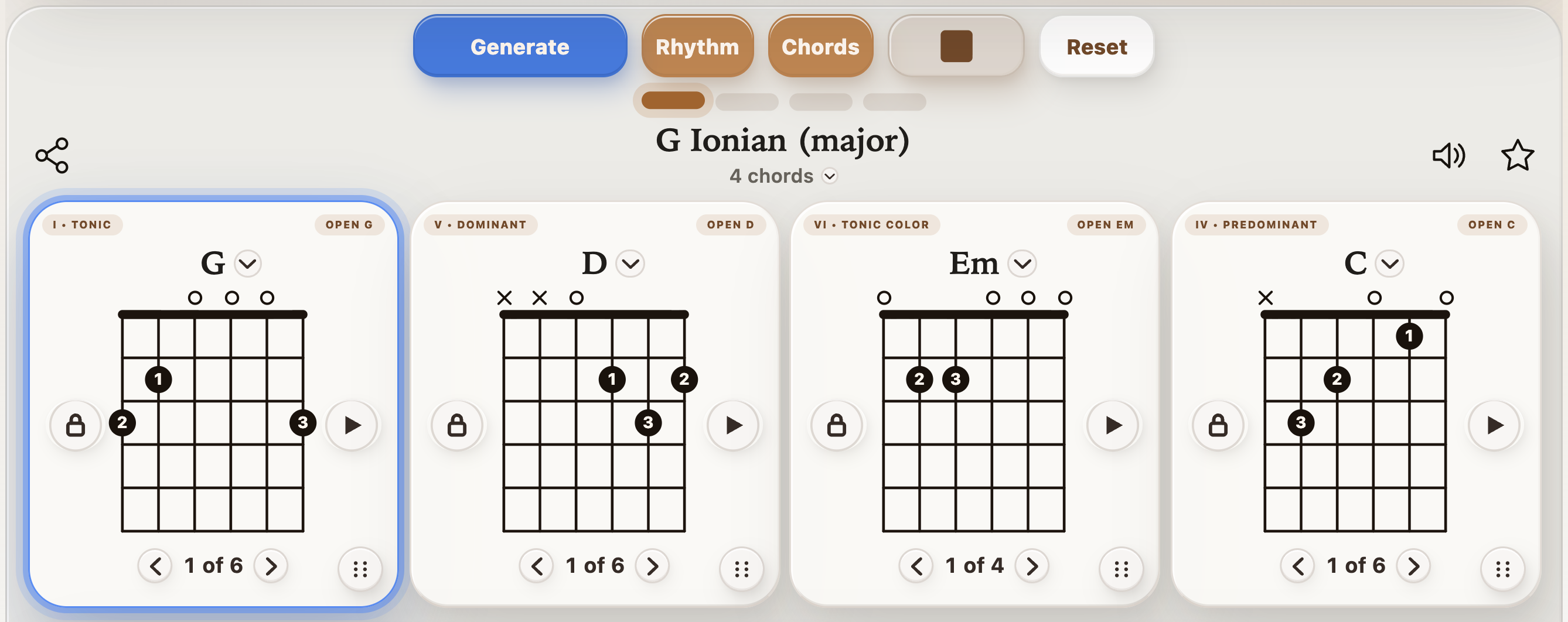
Follow the active chord through a repeating progression as you practice changes and timing.
Daily routine blocks: choose your available time
Use Standard tuning for the chord and fretboard examples below. Start each session by tuning and checking a few notes slowly. The suggested tempos are starting points, not targets you must reach.
A longer session for connecting technique to improvisation.
Add arpeggios, chord-tone phrasing, and a recorded review.
5-minute reset: one minute to tune and warm up, two minutes on the hardest chord pair, one minute on a steady rhythm, and one minute playing the complete loop. Keep this shorter option for days when the longer plan is unrealistic.
The 10-minute chord routine
Swipe or scroll sideways to see all columns.
Minutes
Task
Suggested setup
0–1
Tune, then pick every string of G and D slowly.
Standard tuning; adjust until fretted notes ring clearly.
1–4
Alternate G and D with one change per bar.
4/4, 60 BPM or slower; four beats per chord.
4–7
Play G–D–Em–C with continuous counting.
One downstroke per beat; include C back to G.
7–9
Keep the loop and add quiet upstrokes between beats.
Keep the same tempo; return to downstrokes if timing slips.
9–10
Write a short note and play one relaxed final pass.
Record the chord pair and last clean tempo.
Use the same material throughout the session
G – D – Em – C
Choose the same voicings each time you measure progress. Swap a difficult shape only when testing that change deliberately.
Tune and warm up by picking the notes in two familiar chords.
A relaxed hand position.
2–7
Work on the chord transition that was weakest yesterday.
The same pair, tempo, and beats per chord.
7–11
Practice eighth-note strumming with an accent on beats 2 and 4.
One chord first; then the full loop.
11–15
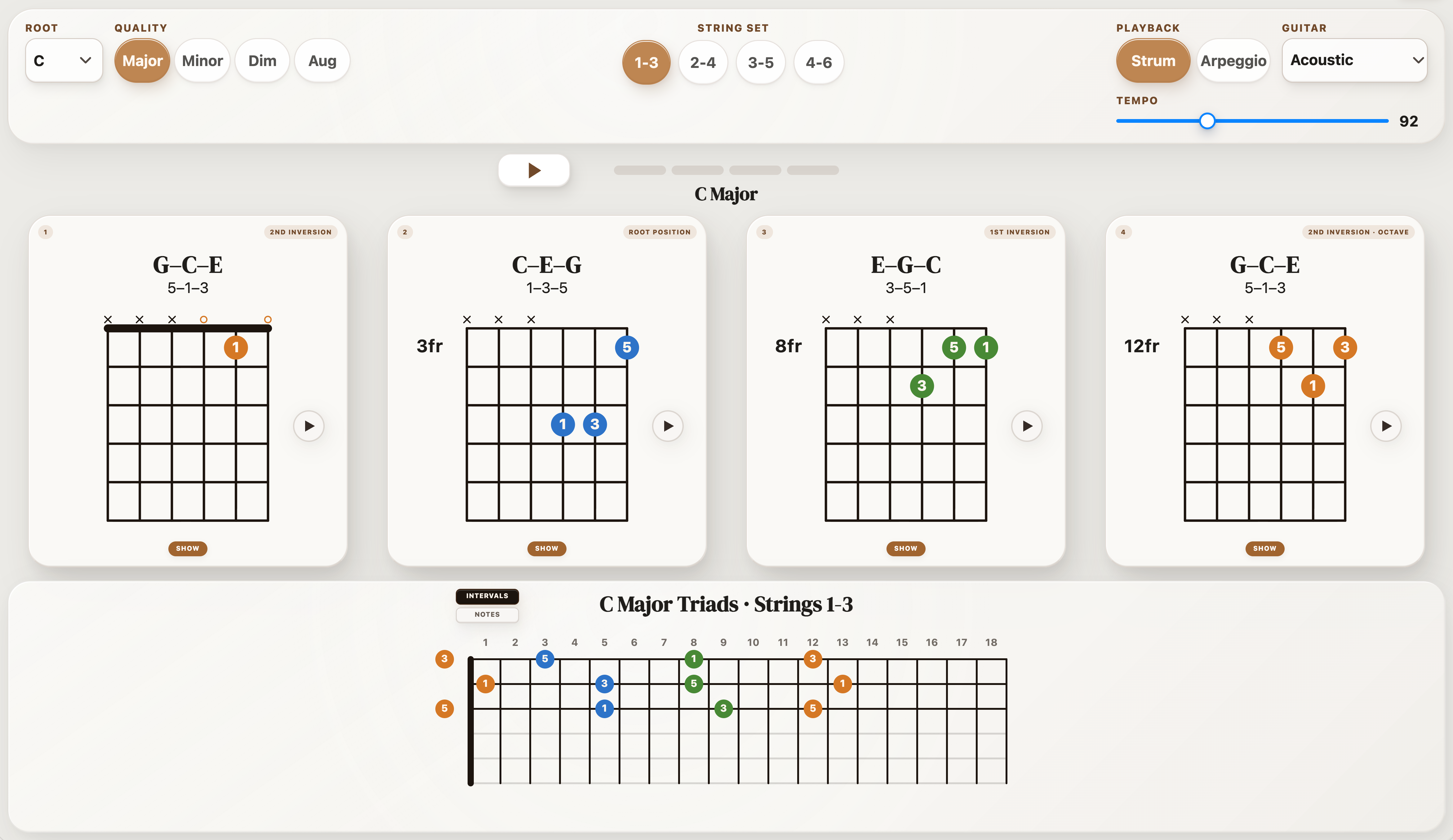
Choose one G major scale shape or one C major triad string set.
A slow tempo and one set of note labels.
15–19
Use your scale notes over G–D–Em–C, or move C–F–G triads.
Short phrases or nearby voicings.
19–20
Log the result and choose the next session’s first task.
One observation you can test again.
Alternate the scale and triad block across days; you do not need both every day. In StrumForge, timed scale playback can guide the shape, while Triad Trainer can strum the inversions or play their notes separately. Then turn off the guided sequence and try the shape yourself.
For the triad block, work on one string set and name the bass note of each inversion.
The 30-minute full routine
Swipe or scroll sideways to see all columns.
Minutes
Task
One useful check
0–3
Tune and play a slow, familiar warmup.
Notes sound clean without squeezing harder.
3–8
Isolate a difficult chord pair, then return to its loop.
The change arrives on the expected beat.
8–13
Play an eighth-note pattern with accents and rests.
The hand keeps moving through the missed strokes.
13–18
Practice one scale shape or triad string set.
You can name roots and thirds, not only fret numbers.
18–23
Play one CAGED arpeggio shape slowly.
Use 60 BPM, quarter notes, and a count-in; reduce tempo if needed.
23–28
Improvise short phrases over a familiar loop.
Land on a chord tone when the harmony changes.
28–30
Record a short pass, listen, and write tomorrow’s task.
Pick one specific change to make.
For the arpeggio block, choose D major in the Arpeggio Trainer and identify D, F♯, and A. For the application block, use a compatible progression such as D–G–A–D. Changing keys in the trainer is a separate drill; its key cycling does not follow a backing progression’s chords.
Use the tools to support the plan
Set the metronome’s Timer for the block you are working on. Use Count-in when you want a moment to prepare. Save a preset if the same rhythm settings recur. In the progression view, save the loop as a favorite so you can return to the same material tomorrow.
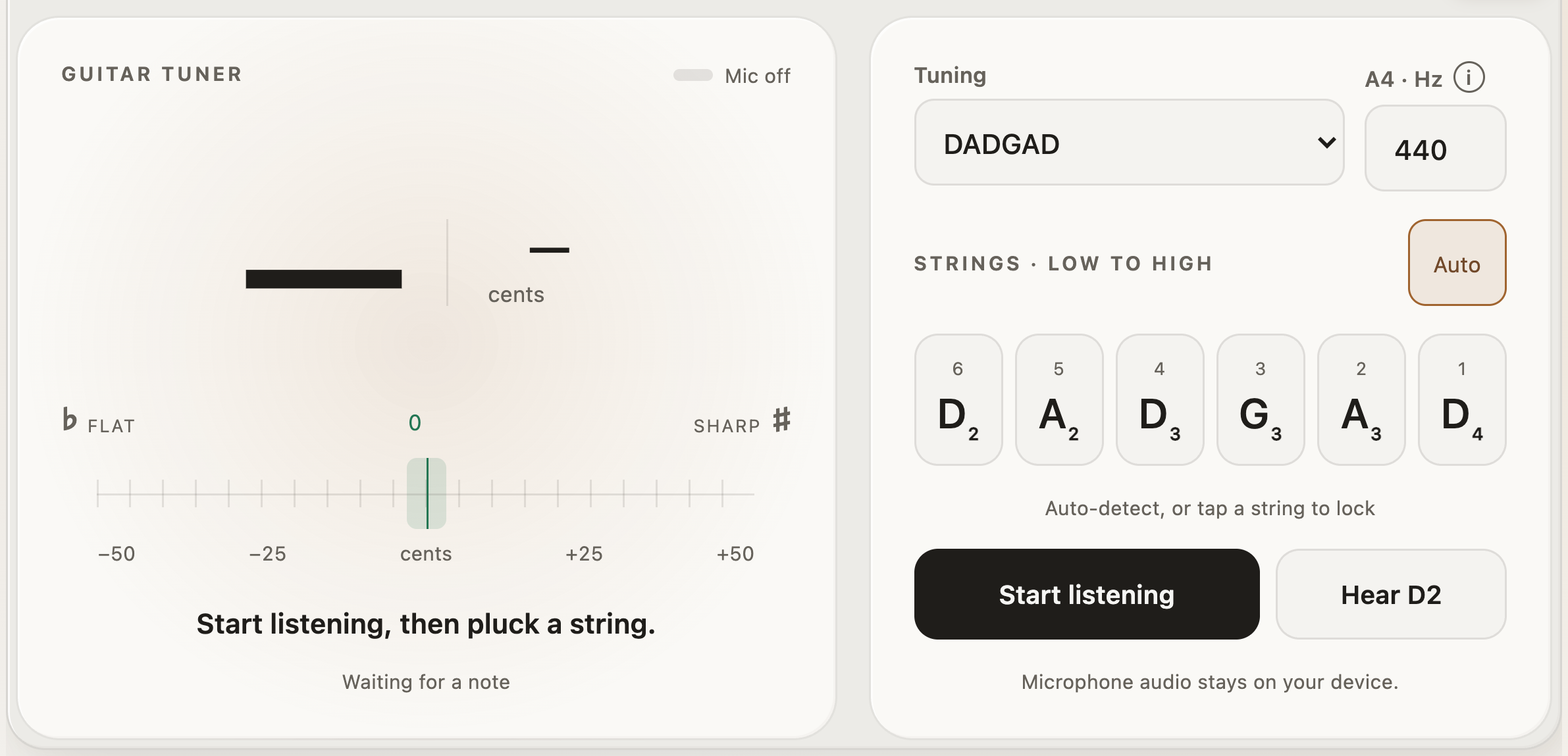
The tuner offers nine tuning presets and chromatic mode. Choose the tuning your exercise expects; changing a tuning preset in the tuner does not transpose the chord diagrams in this guide.
The tuner can prepare alternate-tuning sessions. Use Standard for the exercises on this page.
Use practice history to review sessions and add a manual session when needed. Keep your clean tempo and exercise notes in a notebook or your own practice log; elapsed practice time does not automatically score your playing.
These exercises work with a guitar and a steady pulse. StrumForge offers free progression generation within its daily allowance. Interactive triad and arpeggio trainers, advanced scale playback, the dedicated metronome, tuner, favorites, and practice tracking require StrumForge Pro. Compare the app features and access options.
Weekly review: keep a small practice log
Swipe or scroll sideways to see all columns.
Date
Exercise
Tempo / setup
Result
Next session
Example entry
G → D
60 BPM; four beats per chord
Three clean loops; rushed the fourth.
Repeat before increasing tempo.
Your next session
Chosen chord pair or shape
BPM, rhythm, and position
One specific observation
One adjustment
Compare like with like: the same chord pair, fingering, beats per chord, and tempo. A lower tempo with clearer notes may be a better session than a faster one with stops. At the end of the week, keep exercises that still challenge you and replace one that has become automatic.
Should I repeat the same routine every day?
Keep its structure and one measurable exercise stable. Rotate the musical material or fretboard block when it becomes comfortable. If a session is missed, resume with a manageable plan instead of doubling every block.