

String direction
The left side usually represents the low E string and the right side represents the high E string.
Guitar voicings
Learn how to read guitar chord diagrams, understand strings and frets, place fingers cleanly, mute unused strings, and move from diagrams into real chord changes.
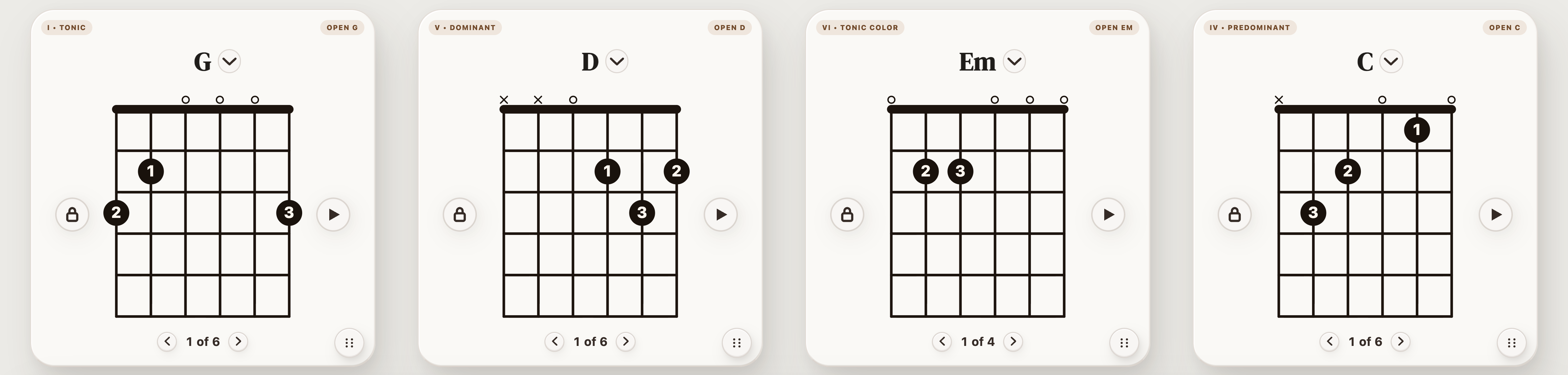
Use these drills to turn static diagrams into clean chord changes.
A chord diagram is a small map of strings, frets, finger placement, open strings, and muted strings.
The left side usually represents the low E string and the right side represents the high E string.
Use the suggested fingers as a starting point, but adjust if a different fingering makes the next chord easier.
An X matters. Muting unused strings keeps the chord clean and prevents muddy low notes.
Pick each string one at a time before strumming. The diagram only helps if every intended note rings clearly.
| When you need... | What to do on guitar |
|---|---|
| To get the idea under your hands | Play one guitar chord diagrams example slowly with a single voicing family before changing anything else. |
| To make the part cleaner | Fix the weakest chord change or rhythm accent first, then return to the full progression. |
| To make it your own | Change one variable at a time: key, capo position, rhythm, register, chord color, or scale focus. |
| To test it in StrumForge | Open a related loop when you want diagrams, groove playback, and timing practice. |
Use the page as a starting point, then move into the app when you need sound, timing, diagrams, and scale context.
Short answers for players using this page as a practice or writing reference.
Read the strings, frets, finger numbers, open strings, and muted strings first, then pick each note to confirm the chord is clean.
Yes. Each linked example opens a four-chord progression in the generator and counts toward the current 5 free daily progression generations.
Yes. Once the loop works, change key or capo position so the idea becomes a fretboard exercise instead of a memorized shape.