

How should I use the guitar voicings hub?
Start with the overview, choose a page that matches the sound or skill you want, then open linked examples in StrumForge when you need playable diagrams and groove playback.
Guitar voicings
Explore guitar voicings for open chords, barre chords, triads, add9 sounds, seventh chords, and progression-friendly fretboard choices.
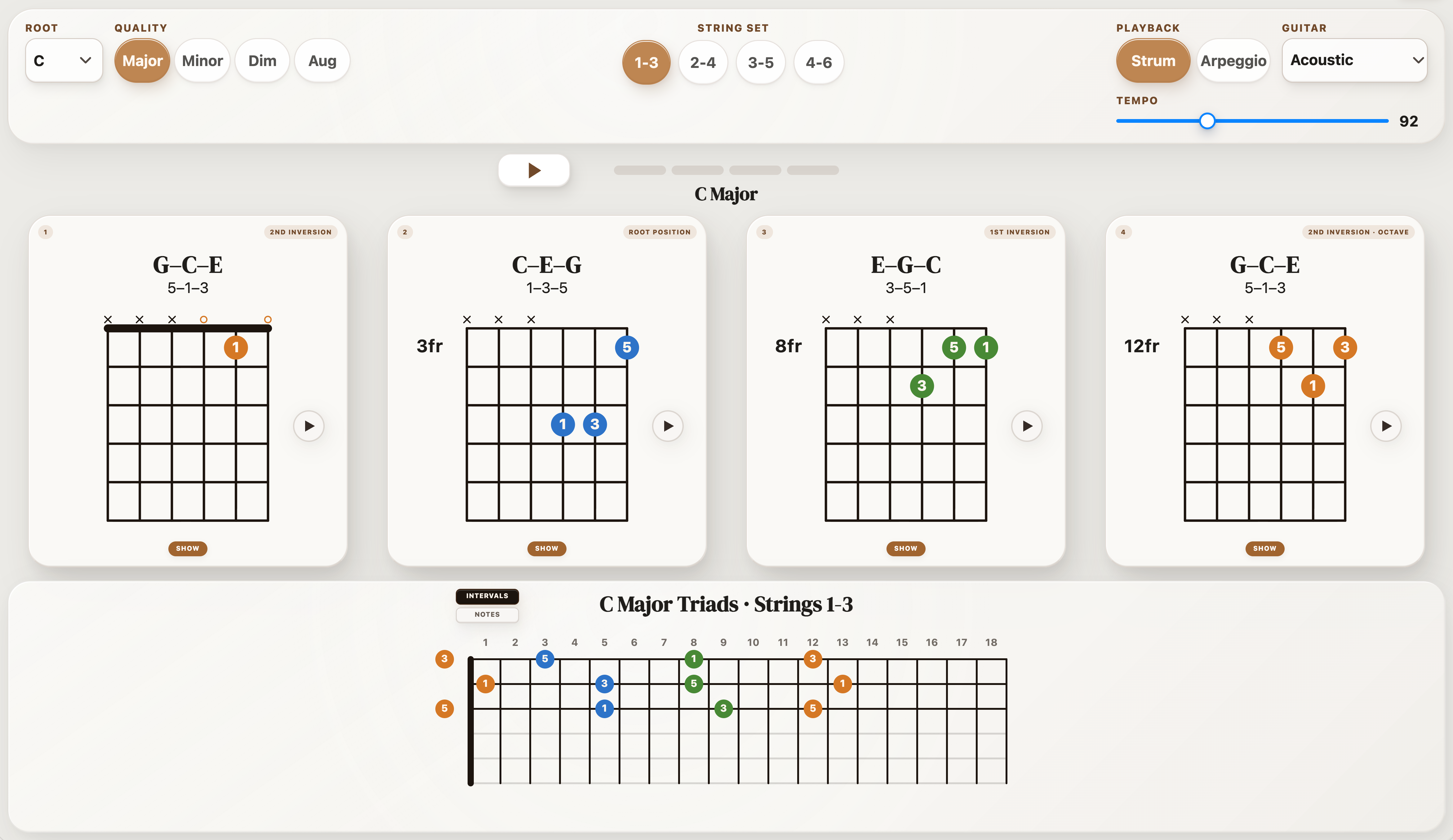
Compare open chords, barre chords, triads, seventh chords, and color voicings in real progressions.
Guitar voicings decide how a progression actually feels. The chord names may stay the same, but open chords, barre chords, triads, add9 shapes, seventh chords, and partial voicings all sit differently in a mix and under the fingers. A good voicing choice can make a simple progression sound finished.
Open chords are usually best when resonance and familiar acoustic movement matter. Barre chords are useful when the key needs to move or the rhythm part needs a consistent grip. Triads keep arrangements clear because they use fewer notes and can move smoothly up the neck. Seventh chords and add9 voicings add color without needing a more complicated chord progression.
The right voicing depends on the job of the part. A chorus may need broad open strings. A verse may need smaller shapes so the vocal has room. A funk or neo-soul part may need compact seventh chords with muting. A fingerstyle part may need chord shapes that keep the bass moving while the upper notes ring.
Practice voicings by keeping the progression constant and changing only the shapes. Play C-G-Am-F with open chords, then with triads, then with barre shapes, then with a few add9 or maj7 colors. Listen for which version supports the rhythm and melody best. That teaches arrangement judgment faster than learning disconnected grips.
Use this hub when a progression is harmonically correct but does not sound right yet. The fix may be a smaller voicing, a higher register, fewer doubled notes, a ringing open string, or a shape that makes the next chord easier to reach. StrumForge can help compare those choices with diagrams and playback.
| If you need... | Use this guitar approach |
|---|---|
| A bigger acoustic sound | Use open chords, ringing strings, and capo-friendly shapes when resonance matters more than tight voice leading. |
| A movable part | Use barre chords or triads when the key needs to change or the same shape family should move around the neck. |
| A cleaner arrangement | Use triads, partial chords, and fewer doubled notes when full six-string shapes crowd the vocal or another instrument. |
| A richer color | Use seventh chords, add9 shapes, suspended chords, and neo-soul voicings when the progression is right but the texture is too plain. |
Choose a specific style, mood, practice problem, theory concept, or songwriting task.
Open the app when you want the page examples to become diagrams, playback, scale context, and practice loops.
Short answers for players using this page as a practice or writing reference.
Start with the overview, choose a page that matches the sound or skill you want, then open linked examples in StrumForge when you need playable diagrams and groove playback.
Choose one progression or concept, slow it down, and repeat it until the weakest chord change, rhythm, or scale target feels controlled.
A chord progression becomes useful faster when the shapes, voicings, rhythm, and scale context are designed for guitar instead of copied from a generic harmony list.