

Harmonic role
Use jazz guitar progressions to decide how much information the guitar part needs. Full chords can sound broad, while triads and partial shapes leave more room.
Guitar voicings
Explore jazz guitar progressions with guitar-focused examples, voicing notes, practice suggestions, songwriting angles, and direct StrumForge generator links.
Want more jazz ideas? StrumForge Premium includes a Jazz Style for generating your own progressions.
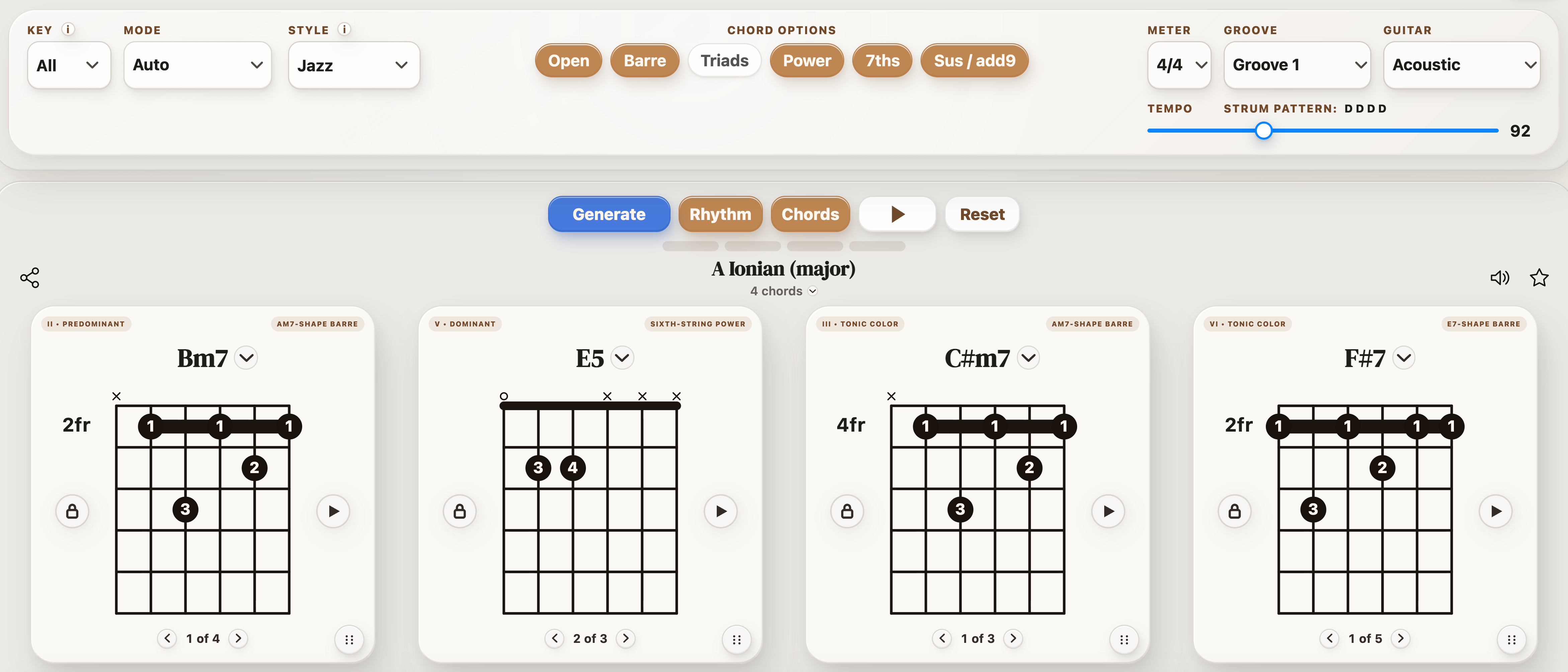
Use these four-chord examples as guitar-friendly starting points. Opening a linked loop in StrumForge counts toward the current 5 free daily progression generations.
Keep the progression simple and use the chord shapes to control register, color, and movement.
Use jazz guitar progressions to decide how much information the guitar part needs. Full chords can sound broad, while triads and partial shapes leave more room.
Try open chords for resonance, barre chords for movable keys, triads for clean arrangements, and seventh or add9 shapes when the progression needs color.
Move between shapes slowly and watch the top note of each chord. Smooth top-note movement often makes a progression sound more intentional.
Change voicings before adding extra chords. A new register or smaller grip can make the same loop work in a verse, chorus, or bridge.
| When you need... | What to do on guitar |
|---|---|
| To get the idea under your hands | Play one jazz guitar progressions example slowly with a single voicing family before changing anything else. |
| To make the part cleaner | Fix the weakest chord change or rhythm accent first, then return to the full progression. |
| To make it your own | Change one variable at a time: key, capo position, rhythm, register, chord color, or scale focus. |
| To test it in StrumForge | Open a related loop when you want diagrams, groove playback, and timing practice. |
Use the page as a starting point, then move into the app when you need sound, timing, diagrams, and scale context.
With StrumForge Premium, select Jazz in the Style menu to generate more ideas. Set Mode to Auto for a broad starting point. Enable 7ths to explore major-seventh, minor-seventh, and dominant-seventh colors. Compare compact voicings and listen to how the upper notes move between chords. Style guides new progressions within your selected key, mode, and chord options.
Short answers for players using this page as a practice or writing reference.
Start with one four-chord loop, slow the tempo down, and keep the same voicing family until the rhythm and chord changes feel automatic.
Yes. Each linked example opens a four-chord progression in the generator and counts toward the current 5 free daily progression generations.
Yes. Once the loop works, change key or capo position so the idea becomes a fretboard exercise instead of a memorized shape.