

Play one clean pass
Use one strum per chord and listen to the complete loop. Fix any transition that forces the tempo to slow down.
Guitar chord progressions
A guitar chord progression is an ordered series of chords that creates movement, tension, and return. The same progression can sound completely different when you change the key, guitar voicings, rhythm, register, tempo, or melody.
Use this page as a starting map. Try one of the essential four-chord examples, learn what its Roman numerals mean, or jump to a guide organized by genre, mood, playing level, or songwriting goal. When you find a useful loop, open it in StrumForge to hear the timing and compare playable guitar diagrams.
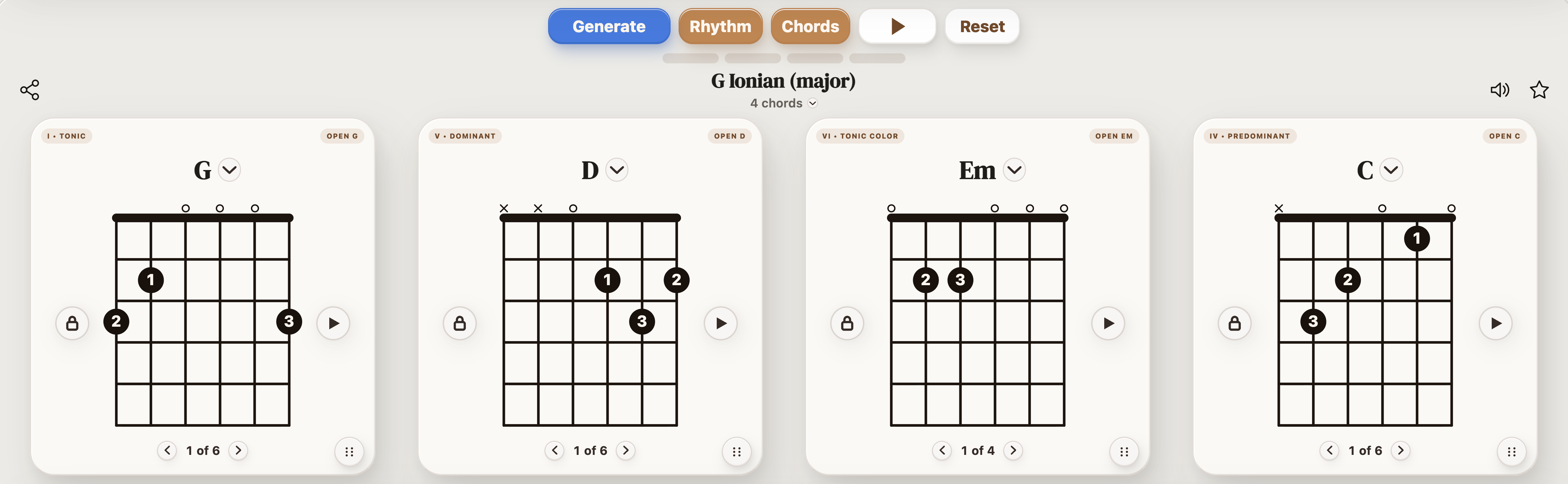
If you are not sure where to begin, choose one row and play it with one steady strum per chord. The Roman numerals describe the relationship between chords; the example shows one guitar-friendly key.
| Musical goal | Formula | Example | Why try it |
|---|---|---|---|
| Familiar major-key loop | I - V - vi - IV | G - D - Em - C | Clear tonic, dominant, relative-minor, and IV movement; useful for hearing how rhythm and voicing change a familiar formula. |
| Minor-first variation | vi - IV - I - V | Em - C - G - D | Uses the same chord family as the first row but starts in a more reflective place. |
| Direct rock movement | I - flat VII - IV - I | A - G - D - A | The flat VII removes the polished dominant cadence and creates broader rock-oriented motion. |
| Natural-minor loop | i - VI - III - VII | Am - F - C - G | A practical minor center that opens into three major chords and loops without a strong dominant. |
| Three-chord foundation in four slots | I - IV - V - IV | E - A - B - A | Introduces the primary I, IV, and V roots while using the final IV to keep the loop moving. |
| Classic turnaround | I - vi - IV - V | C - Am - F - G | Moves from the tonic through relative minor and IV before a strong dominant return. |
| Suspended open-string color | I - V - vi - IV | Gadd9 - Dsus4 - Em7 - Cadd9 | Keeps a familiar formula while changing the guitar texture through supported color voicings. |
| Heavy minor-root movement | i - VI - III - VII | E5 - C5 - G5 - D5 | Power chords remove the thirds and put more weight on the root movement and rhythm. |
These are starting points, not rules. Keep the formula and change the rhythm, voicing, key, or starting chord before assuming you need a completely different progression.
Roman numerals describe where a chord comes from inside a key. Uppercase numerals usually represent major chords, lowercase numerals represent minor chords, and symbols such as flat VII identify a root outside the ordinary major-key scale.
For example, I - V - vi - IV becomes G - D - Em - C in G major, C - G - Am - F in C major, D - A - Bm - G in D major, and A - E - F#m - D in A major.
The chord names change, but the relationship remains the same. That is why learning the formula is more useful than memorizing one set of shapes. You can move the progression to a better vocal range or a more comfortable guitar key without losing its harmonic identity.
The tonic, labeled I or i, is the tonal home. IV or iv moves away from home, V or V7 creates strong tension, vi is the relative minor in a major key, flat VII creates broad rock movement, and a borrowed iv supplies minor color inside a major key. Hear each role in context before treating the symbol as an abstract rule.
| Symbol | Meaning | Guitar example |
|---|---|---|
| I or i | Tonic; the tonal home | G in G major or Em in E minor |
| IV or iv | Movement away from home, often with an open or expansive sound | C in G major or Am in E minor |
| V or V7 | Strong tension that tends to return to the tonic | D or D7 returning to G |
| vi | Relative minor inside a major key | Em in G major |
| flat VII | Major chord one whole step below the tonic | G in an A-centered rock loop |
| borrowed iv | Minor version of the major-key IV chord | Fm in C major |
Choose the progression whose hardest chord can still arrive in time. A simpler voicing played with a steady pulse is more useful than a full shape that breaks the rhythm.
Use these guides when the musical style should shape the harmony, voicing, rhythm, and arrangement.
Treat the emotion as a tendency shaped by melody, rhythm, register, dynamics, and harmonic context.
A useful progression solves a musical problem. Choose a rhythm page when timing is the problem, a voicing page when the chords feel crowded, a key page when the shapes or vocal range are wrong, and a genre or mood page when the sound itself is unclear.
Use one strum per chord and listen to the complete loop. Fix any transition that forces the tempo to slow down.
Start with open chords, barre chords, triads, or power chords rather than changing approach on every chord. A consistent register helps the progression sound like one part.
Use sustained chords for space, steady eighth notes for movement, muted attacks for control, or arpeggios when the individual notes matter. Keep the right hand moving through difficult changes.
The top note of each chord creates a small melody. Try another inversion or triad if those notes jump awkwardly or compete with the vocal.
Transpose the key, change the starting chord, replace one voicing, or alter the rhythm. Keeping the other variables fixed makes it easier to hear whether the revision improved the part.
StrumForge is useful when a chord formula needs to become something playable. Open an example to hear the timing, view standard-tuning guitar diagrams, compare supported voicings, and change the key or rhythm without losing the original idea.
The generator supports four-chord progressions, plus eight- and twelve-chord progressions in Pro. A three-chord idea can repeat one chord across two positions, and a one- or two-chord vamp can repeat deliberately. Use longer progressions to develop a section; a complete song still needs decisions about form, melody, and arrangement.
Explore additional style and mood pages after the priority starting points above.
A guitar chord progression is an ordered series of chords played as a repeating loop or longer song section. The chord order creates movement and return, while guitar voicings, rhythm, register, and melody determine how the progression feels in practice.
Try G - D - Em - C or Em - C - G - D. Both use common open chords and demonstrate how the same chord family changes character when the starting point changes.
Roman numerals show each chord's position inside a key. For example, I - V - vi - IV is G - D - Em - C in G major and C - G - Am - F in C major. The formula stays the same when the key changes.
They can support a complete section or even several sections, but the finished song also depends on melody, rhythm, lyrics, dynamics, arrangement, and form. A verse and chorus can use the same chords with different guitar parts.
Change the voicings, highest-note movement, rhythm, register, dynamics, starting chord, or one carefully chosen borrowed chord. The progression does not need to be rare if the guitar part has a clear musical role.
Use open chords for resonance, barre chords for movable full shapes, triads for a cleaner register, and power chords when root movement and rhythm matter more than major-versus-minor color. Choose one family that fits the section before mixing approaches.
Yes. The quick-start examples link to four-position StrumForge loops with playback, standard-tuning guitar diagrams, and supported voicing controls.