Practice Guitar Scales Over Chord Progressions: Target Notes
To practice scales over chord progressions, first choose notes that fit the harmony, then decide where each phrase should land. Start with one position and a short loop. The examples below move from a shared scale to chord-tone targets and finally to a modal sound.
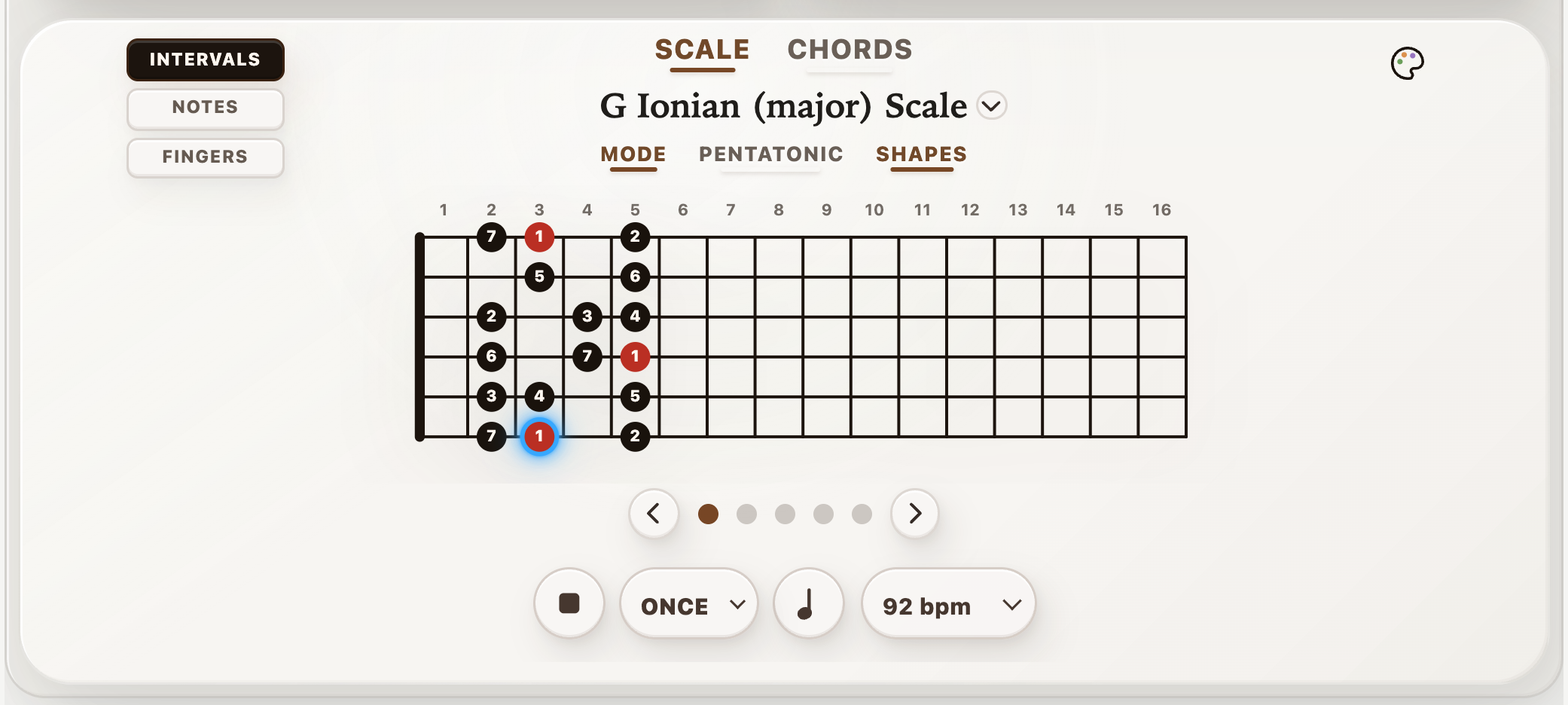
Follow the highlighted note during scale playback, then practice the phrase yourself.
One scale, four chords: C major over C–G–Am–F
Hear the backing loop first
C – G – Am – F
Use one chord per bar. The notes C, D, E, F, G, A, and B belong to C major, and each chord is built from that collection. Start at 60 BPM so you have time to hear the next chord.
A shared scale is a starting point, not a promise that every note will sound equally settled over every chord. Over C, E is the major third; over F, E is a major seventh with a different pull. Let your ear compare a held note before adding speed.
Swipe or scroll sideways to see all columns.
Bar / chord
Chord tones
First landing note to try
1 · C
C–E–G
E, the third
2 · G
G–B–D
D, the fifth
3 · Am
A–C–E
C, the third
4 · F
F–A–C
A, the third
Play only the target on beat one and let it ring for the bar. Say the chord name as it changes. Once you can hear all four targets, add one or two nearby scale notes before the next landing.
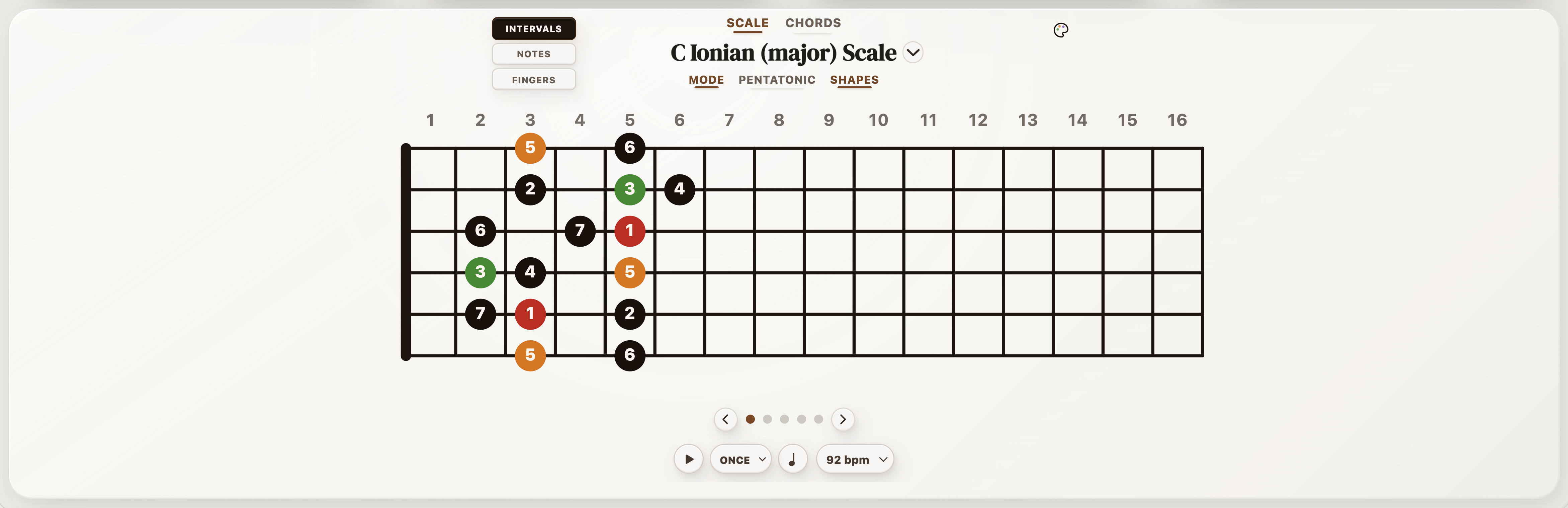
Triad highlighting identifies the selected scale’s tonic triad. Over this loop, locate the other chords’ targets from the table; the colored C-major markers do not automatically become each chord’s triad.
Turn the targets into a short phrase
Swipe or scroll sideways to see all columns.
Chord
Four quarter notes to try
Why the first note works
C
E – G – E – D
E is the third of C.
G
D – B – G – B
D is the fifth of G.
Am
C – E – A – G
C is the third of Am.
F
A – C – A – G
A is the third of F.
These note names describe one possible phrase, not a required fingering. Find a comfortable octave in one C major shape. Play one note per beat, then replace beats 2 and 4 with rests. Listen to the final G lead back to E over C. If a leap is awkward, use a nearer chord tone in the same position.
Record one pass. Listen for the target notes landing with the chord changes rather than a fraction after them. Use the scale technique exercises separately if finding the notes interrupts the rhythm.
Start smaller with A minor pentatonic
Five notes over four chords
Am – F – C – G
Begin with A, C, D, E, and G. Make a two- or three-note phrase, repeat it, and leave space between repetitions.
The F chord contains F, A, and C. A minor pentatonic supplies A and C, so you already have two strong targets over F even though F itself is absent from the scale. To target the F root, add F deliberately; you are now using a note outside the five-note pentatonic set.
Swipe or scroll sideways to see all columns.
Chord
Targets inside A minor pentatonic
Optional added target
Am
A, C, E
None needed.
F
A, C
F, the root.
C
C, E, G
None needed.
G
G, D
B, the major third.
Adding F and B gives you the remaining notes of A natural minor / C major. Add one target at a time so you can hear why it is useful instead of treating a larger scale as an automatic improvement.
Hear a modal difference with D Dorian
Keep D minor as home
Dm7 – G7 – Dm7 – G7
Use D, E, F, G, A, B, and C. D Dorian shares C major’s notes, but the D minor center changes their roles.
The note B is Dorian’s natural sixth and the third of G7. Play A–B–C over Dm7, then hold B when G7 arrives. Compare that with B♭, the sixth of D natural minor: B♭ does not belong to the G7 chord and creates a different tension against its B natural.
You do not need to change scale on every chord in this example. First hear the common note collection and the chord-tone targets. For more modal context, explore the guitar modes guides.
Use arpeggios to learn the notes you want to land on
Before connecting a scale phrase, outline each chord’s arpeggio slowly. For Cmaj7–Am7–Dm7–G7, use C–E–G–B, A–C–E–G, D–F–A–C, and G–B–D–F. Keep the four chords in one comfortable region where possible.
Seventh-chord targets
Cmaj7 – Am7 – Dm7 – G7
First play only roots, then thirds. On the next pass, connect two chord tones with one passing note from C major.
The Arpeggio Trainer can isolate one chord quality and shape. Select the root and quality needed for your exercise; this reference capture shows D major 7.
In StrumForge, use Arpeggio Trainer to learn one shape with note or interval labels. Set quarter notes, a slow tempo, and Loop. Turn Cycle keys off while studying one chord. That toggle moves through fourths every four passes; it does not synchronize the trainer with a backing progression. Then return to the progression view and play your own phrase over its loop.
These exercises work with a guitar and a steady pulse. StrumForge offers free progression generation within its daily allowance. Interactive triad and arpeggio trainers, advanced scale playback, the dedicated metronome, tuner, favorites, and practice tracking require StrumForge Pro. Compare the app features and access options.
A ten-minute scale-over-chords routine
Minutes 0–2: Listen to C–G–Am–F and play one root per bar.
Minutes 2–4: Land on E, D, C, and A as the chords change.
Minutes 4–6: Add one neighboring C major note before each target.
Minutes 6–8: Repeat a short rhythm with different chord-tone endings.
Minutes 8–10: Record a pass and note which landing was late or uncertain.
Do I need a new scale for every chord?
Not for the diatonic loops above. A shared scale can cover the harmony while your target notes change. Borrowed chords and secondary dominants may introduce notes outside that collection; inspect those chord tones before reusing the same scale.
Why does my solo still sound like an exercise?
Reduce the note count, repeat a rhythmic idea, and leave a gap. A phrase with a clear destination usually tells you more than another uninterrupted run through the box.