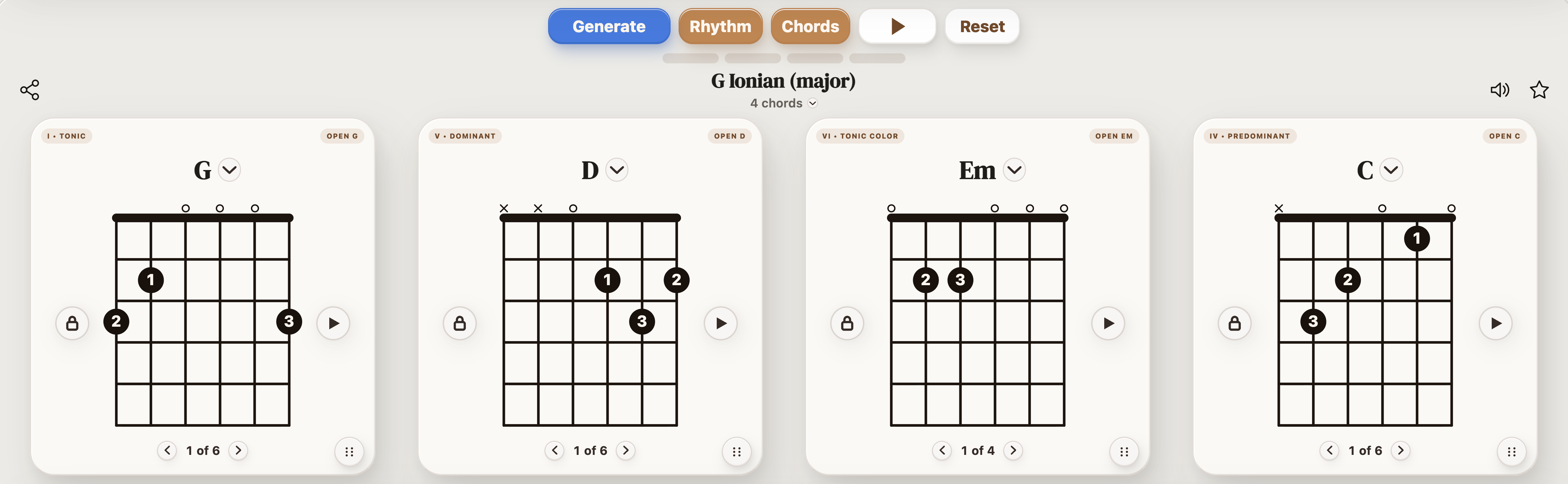
What is the most common guitar chord progression?
There is no single progression used more than every other one in all styles, but I – V – vi – IV is one of the most useful four-chord patterns to learn. In G major, that is: G – D – Em – C. The same progression in D major is: D – A – Bm – G.
What are the most important guitar chords to learn for progressions?
The I, IV, and V chords are a useful starting point because they form the foundation of many major-key progressions. Adding the vi chord gives you access to many common four-chord patterns such as I–V–vi–IV and vi–IV–I–V.
What does I–V–vi–IV mean?
The Roman numerals refer to chords built from different degrees of a major scale. In G major: I = G, V = D, vi = Em, and IV = C. So I–V–vi–IV becomes G–D–Em–C.
Why are some Roman numerals uppercase and some lowercase?
Uppercase numerals represent major chords and lowercase numerals represent minor chords. For example, I – V – vi – IV contains three major chords and one minor chord.
Are the same chord progressions used in different keys?
Yes. The formula remains the same while the chord names change. For example, G – D – Em – C and D – A – Bm – G are both I–V–vi–IV progressions.
Do four-chord progressions need four different chords?
No. A progression can repeat one or more chords. For example, G – C – D – C contains four positions but only three different chords.
What is a good minor guitar chord progression?
A useful progression to learn is Am – F – C – G, which can be analyzed as i – VI – III – VII in A minor. Another simple example is Em – D – C – D in E minor.
How do I transpose a chord progression?
Identify the Roman numeral formula, choose a new key, and replace each chord with the chord occupying the same scale degree in the new key. For example, G – D – Em – C (I – V – vi – IV) becomes A – E – F#m – D in A major.
Should I memorize chord names or Roman numerals?
Learn both. Chord names tell you what to physically play, while Roman numerals show you the relationship between the chords and make it easier to transpose and recognize the same progression in different keys.
Can I practice these progressions in StrumForge?
Yes. Each progression example retains its playback control and direct StrumForge link so you can hear the four-chord loop, follow the guitar diagrams, change tempo, and experiment with available voicings.