

How should I use the guitar keys hub?
Start with the overview, choose a page that matches the sound or skill you want, then open linked examples in StrumForge when you need playable diagrams and groove playback.
Guitar keys
A guitar key hub for diatonic chords, common progressions, beginner-friendly shapes, barre chord options, and scale context.
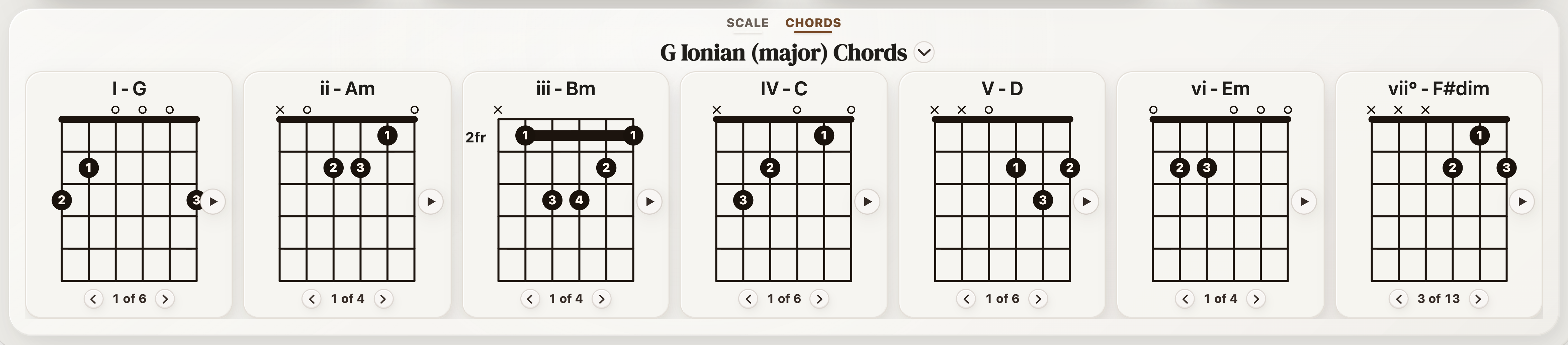
Each key page shows diatonic chords, common progressions, beginner-friendly options, barre chord notes, and scale context.
A guitar key is more than a scale name. It is a family of chords, a set of common progressions, and a collection of voicings that may or may not be comfortable under the fingers. G major is friendly because G, C, D, and Em are open. A major is bright and powerful, but more of its minor chords require barre shapes.
Diatonic chord tables show the default chords that come from the key. In a major key the pattern is I, ii, iii, IV, V, vi, vii°. In natural minor it is i, ii°, III, iv, v, VI, VII. Guitarists can use that map to understand why a progression works before deciding which shapes to play.
The easiest key for a song is not always the theoretical default. A singer might need the progression moved up a step, while the guitarist might want open strings and familiar shapes. Capos, triads, partial barres, and alternate tunings can all keep the harmonic idea intact while making the part playable.
Use the key pages to see common formulas in specific keys. I-V-vi-IV in G becomes G-D-Em-C. The same formula in D becomes D-A-Bm-G, which introduces Bm as a barre chord unless you simplify or use a capo. This is the practical difference that matters during writing and practice.
After choosing a key, use StrumForge to hear the progression, follow chord diagrams, and practice matching scales. The goal is not just to name the key; it is to make the key feel natural on the fretboard.
| If you need... | Use this guitar approach |
|---|---|
| A beginner-friendly key | Start with C, G, D, A, E, Am, Em, or Dm and notice which chords are open, which need a barre, and which can be simplified. |
| The diatonic chord family | Use the key pages to see the I, ii, iii, IV, V, vi, and vii chords that naturally belong together. |
| A song key that fits the singer | Move the same progression to a new key or capo position when the vocal range matters more than the original guitar shapes. |
| Scale and chord context | Practice the key by looping one progression, then target chord tones from the matching scale instead of running the scale mechanically. |
Choose a specific style, mood, practice problem, theory concept, or songwriting task.
Open the app when you want the page examples to become diagrams, playback, scale context, and practice loops.
Short answers for players using this page as a practice or writing reference.
Start with the overview, choose a page that matches the sound or skill you want, then open linked examples in StrumForge when you need playable diagrams and groove playback.
Choose one progression or concept, slow it down, and repeat it until the weakest chord change, rhythm, or scale target feels controlled.
A chord progression becomes useful faster when the shapes, voicings, rhythm, and scale context are designed for guitar instead of copied from a generic harmony list.