

How should I use the guitar theory hub?
Start with the overview, choose a page that matches the sound or skill you want, then open linked examples in StrumForge when you need playable diagrams and groove playback.
Guitar theory
A guitar theory hub for harmony, borrowed chords, secondary dominants, turnarounds, modes, and practical progression writing.
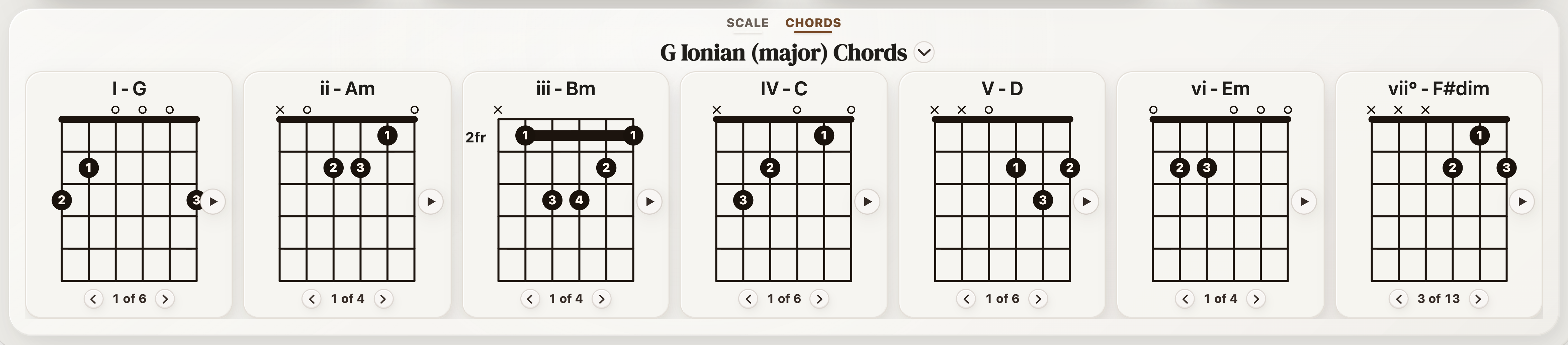
Use harmony, borrowed chords, secondary dominants, modes, and turnarounds as guitar decisions.
Guitar theory should explain what to try next with your hands. The point is not to memorize terms in isolation. The point is to understand why a chord pulls forward, why a borrowed chord changes the color, why a turnaround brings the loop home, or why a mode sounds different from ordinary major and minor.
Start with the sound, then name it. Borrowed chords often work because they bring a darker or brighter chord from a parallel key. Secondary dominants work because they briefly point at a chord inside the progression. Turnarounds work because they create a return path. Modes work because a tonal center is paired with a specific color note or chord.
On guitar, theory also depends on voicing. A secondary dominant played as a full barre chord can sound forceful, while a small seventh-chord shape on the middle strings may sound smooth. A borrowed flat VI can feel cinematic with open strings, heavy with power chords, or subtle with triads. The same harmonic idea changes when the register and texture change.
Use the theory pages when a progression feels close but unfinished. If the loop needs more pull, try a dominant chord before the target. If it needs surprise, borrow one chord from the parallel minor or major. If it needs smoother movement, use inversions, triads, or seventh chords so the top notes move by step.
StrumForge is useful for this kind of theory because the idea can be tested immediately. Open a progression, listen to the loop, look at the chord shapes, and decide whether the theory creates a better guitar part. If it does not sound better, simplify it. Theory should support the song, the practice goal, and the fretboard, not decorate the page.
| If you need... | Use this guitar approach |
|---|---|
| A progression that needs direction | Use roman numerals and diatonic chords to see where the loop is stable, where it pulls, and where it can resolve. |
| A stronger return home | Use secondary dominants, turnarounds, and circle-of-fifths movement when the progression needs more forward pull. |
| A new color without a new key | Use borrowed chords and modal interchange when the loop needs contrast but should keep the same tonal center. |
| A playable theory test | Try the idea with triads or small seventh-chord shapes first. If the sound is not obvious, simplify the voicing. |
Choose a specific style, mood, practice problem, theory concept, or songwriting task.
Open the app when you want the page examples to become diagrams, playback, scale context, and practice loops.
Short answers for players using this page as a practice or writing reference.
Start with the overview, choose a page that matches the sound or skill you want, then open linked examples in StrumForge when you need playable diagrams and groove playback.
Choose one progression or concept, slow it down, and repeat it until the weakest chord change, rhythm, or scale target feels controlled.
A chord progression becomes useful faster when the shapes, voicings, rhythm, and scale context are designed for guitar instead of copied from a generic harmony list.