

Harmonic role
Use guitar harmony guide to explain why a chord pulls, surprises, resolves, or changes color inside the progression.
Guitar theory
Explore guitar harmony guide with guitar-focused examples, voicing notes, practice suggestions, songwriting angles, and direct StrumForge generator links.
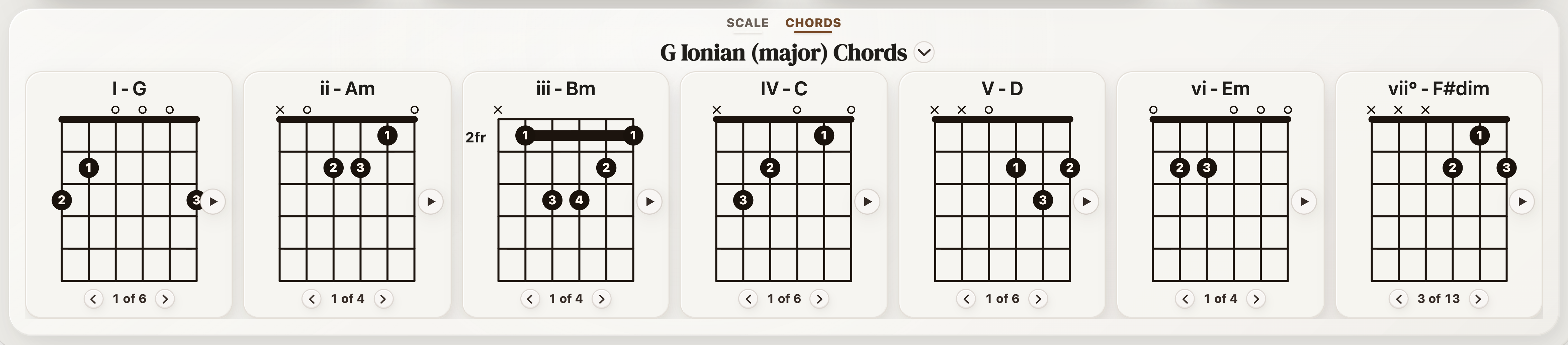
Use these examples to connect chord function, color, and voice leading to playable guitar shapes.
Use the concept to make one clearer guitar decision.
Use guitar harmony guide to explain why a chord pulls, surprises, resolves, or changes color inside the progression.
Try the concept with small shapes first. Triads and seventh-chord grips often make the voice leading easier to hear.
Loop the moment where the theory happens. Practice the chord before it, the target chord, and the transition between them.
Keep the idea only if it improves the part. A borrowed chord or dominant color should create a sound you can hear immediately.
| When you need... | What to do on guitar |
|---|---|
| To understand the sound | Listen for the chord movement or scale degree that makes guitar harmony guide different from the plain major or minor version. |
| To make it playable | Try the idea with small triads or seventh-chord shapes before using full six-string grips. |
| To use it in a progression | Loop the chord before the change, the color chord, and the chord after it until the pull or surprise is easy to hear. |
| To test it in StrumForge | Open a related loop when you want diagrams, groove playback, and scale context for the same idea. |
Use the page as a starting point, then move into the app when you need sound, timing, diagrams, and scale context.
Short answers for players using this page as a practice or writing reference.
Start with one four-chord loop, slow the tempo down, and keep the same voicing family until the rhythm and chord changes feel automatic.
Yes. Each linked example opens a four-chord progression in the generator and counts toward the current 5 free daily progression generations.
Yes. Once the loop works, change key or capo position so the idea becomes a fretboard exercise instead of a memorized shape.