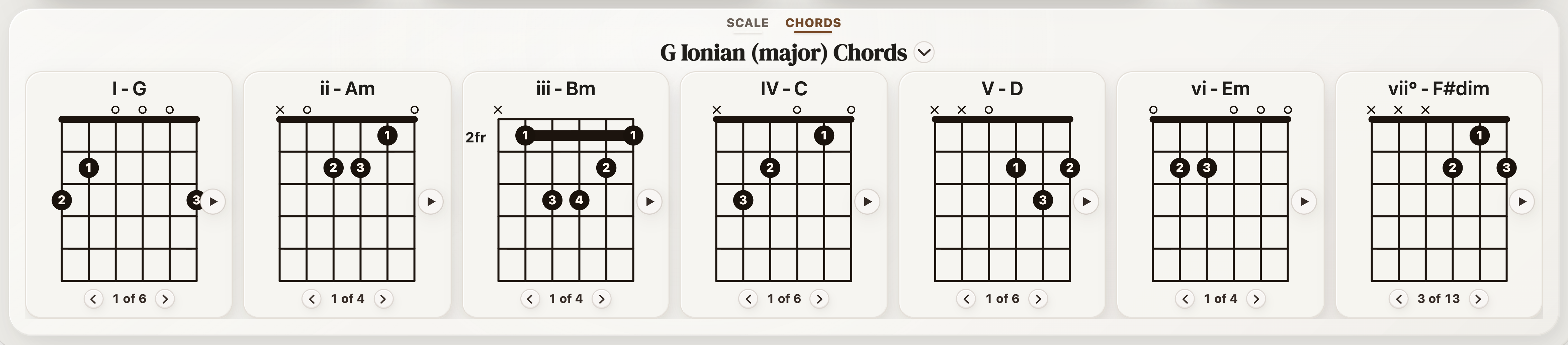
G major’s chord family: G, Am, Bm, C, D, Em, and F♯dim, with their scale-degree labels.
How it works on guitar
Use the concept as a practical way to choose, move, or revise chords.
Roman numerals name chord function instead of one fixed chord. That matters on guitar because the same progression can be played as C-G-Am-F, G-D-Em-C, or D-A-Bm-G while keeping the same musical shape.
Use numerals to transpose for vocal range, capo placement, or easier open chords. If a page says I-V-vi-IV, the sound comes from the relationship between the chords, not from C major specifically.
Concept
Guitar meaning
Example
I
Home chord or tonic
C in C major, G in G major
V
Dominant pull back to I
G in C major, D in G major
vi
Relative minor color
Am in C major, Em in G major
IV
Open, stable lift away from I
F in C major, C in G major
Practice approach
Keep the example small enough that your ear can identify the concept.
Play one keyUse the table example in one open-position key before transposing.
Name the functionSay the roman numeral or borrowed-chord role before playing the change.
Move the voicingTry a smaller triad or seventh-chord grip so the theory is audible, not muddy.
Write one variationChange one chord in a familiar progression and decide whether the sound improves.
Guitar practice app Use the native apps for daily practice, saved ideas, and longer sessions.
Features See the progression, playback, diagram, and scale tools in one place.
FAQ
Short answers for players using this page as a practice or writing reference.
What is roman numeral chord progressions for guitar?
Roman numerals name chord function instead of one fixed chord. That matters on guitar because the same progression can be played as C-G-Am-F, G-D-Em-C, or D-A-Bm-G while keeping the same musical shape.
How should I practice this on guitar?
Choose one short progression, play it slowly with clean voicings, then name the chord function before moving to another key.
Should I memorize the theory first?
No. Hear it in a progression, play it in one key, then use the name to move the idea elsewhere.
Can I use StrumForge with this theory concept?
Yes. Open a related progression in StrumForge, change key or voicing, and listen for the specific function described on this page.