

What is diatonic chords for guitar?
Diatonic chords are the chords built from the notes of a key. They give you the default chord family before you borrow colors from another key or add secondary dominants.
Guitar theory
Learn the diatonic chords in guitar-friendly keys and how they become common progressions, chord families, and practice loops.
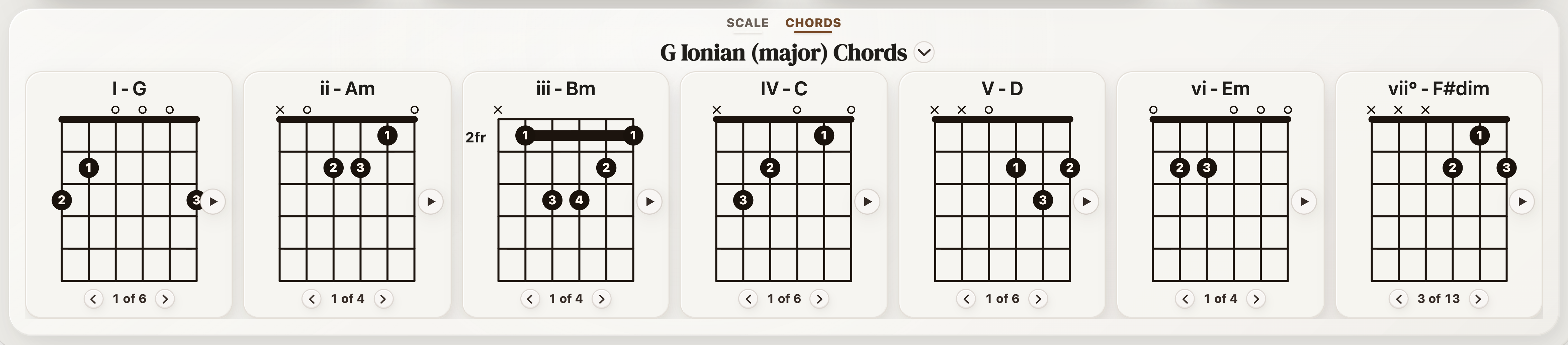
Use the concept as a practical way to choose, move, or revise chords.
Diatonic chords are the chords built from the notes of a key. They give you the default chord family before you borrow colors from another key or add secondary dominants.
On guitar, start with the most playable members of the family. In G major, G, C, D, and Em are open and practical; Bm is diatonic too, but it may need a barre or simplified voicing.
| Concept | Guitar meaning | Example |
|---|---|---|
| Major key | I ii iii IV V vi vii° | C Dm Em F G Am Bdim |
| Natural minor key | i ii° III iv v VI VII | Am Bdim C Dm Em F G |
| Common guitar use | I, IV, V, vi | Most pop, folk, rock, and country loops start here |
Keep the example small enough that your ear can identify the concept.
Open a related progression, change one chord or voicing, and listen for the theory in context.
Short answers for players using this page as a practice or writing reference.
Diatonic chords are the chords built from the notes of a key. They give you the default chord family before you borrow colors from another key or add secondary dominants.
Choose one short progression, play it slowly with clean voicings, then name the chord function before moving to another key.
No. Hear it in a progression, play it in one key, then use the name to move the idea elsewhere.
Yes. Open a related progression in StrumForge, change key or voicing, and listen for the specific function described on this page.