

How should I use the guitar songwriting hub?
Start with the overview, choose a page that matches the sound or skill you want, then open linked examples in StrumForge when you need playable diagrams and groove playback.
Guitar songwriting
A practical hub for guitar songwriting with chord progression workflows, section writing, melody support, and comparison guides.
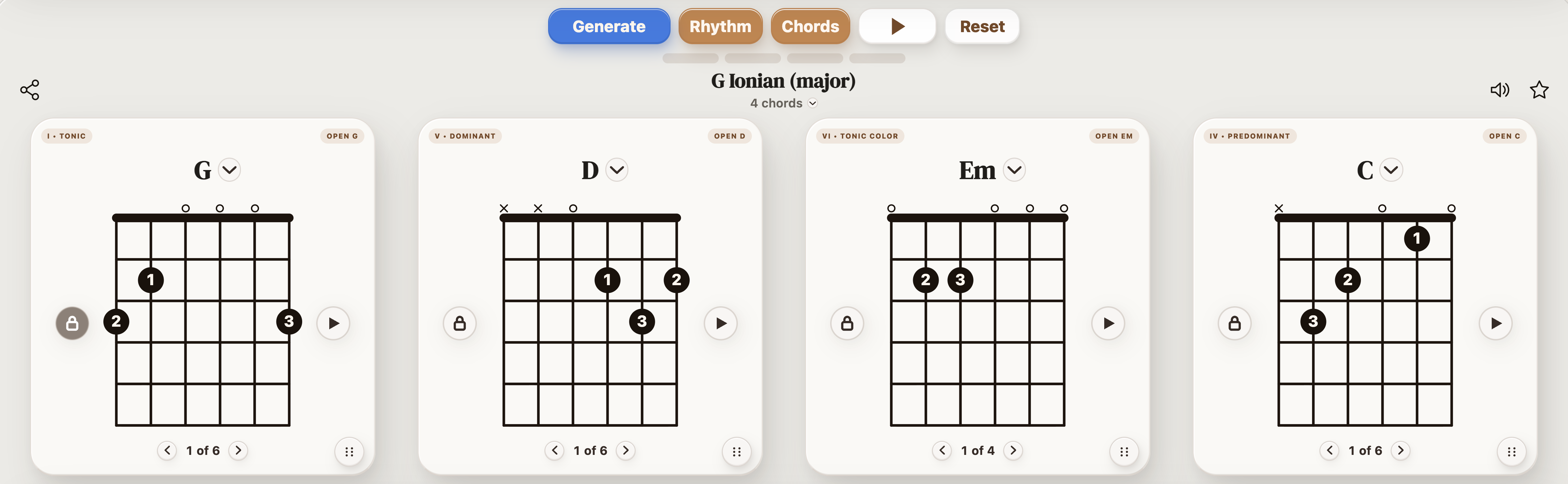
Use chord progressions as verse, chorus, bridge, riff, and melody starting points.
Guitar songwriting gets easier when the first idea is playable. A chord progression does not need to be rare or theoretically clever to work. It needs to give the section a job: support a vocal phrase, lift into a chorus, hold tension in a verse, leave space for a riff, or make a bridge feel like a real contrast.
Start by deciding what the section needs to do. A verse often benefits from a loop that can repeat without sounding finished too quickly. A chorus usually wants a clearer arrival, a wider register, or a stronger rhythm. A bridge can use a borrowed chord, secondary dominant, new bass movement, or different voicing family to reset the ear before the final chorus. The pages below cover those writing choices from different angles.
Four-chord progressions are useful because they give you enough movement to shape a melody while staying simple enough to revise. If a loop feels bland, change the rhythm before adding more chords. If the melody feels boxed in, change the key or use a capo. If the chorus does not lift, try higher voicings, a brighter first chord, or a stronger dominant before the return.
Comparison pages are included for practical workflow decisions. Some tools are better for notation, full arrangement planning, or piano-based theory. StrumForge is focused on guitar-first progression generation: playable diagrams, groove playback, scale context, and quick revision when you want to hear and play the idea immediately.
Use this hub when you want a writing session to turn into sound quickly. Pick a songwriting page, open an example progression, play it for several minutes, and make one decision: keep it, change one chord, change the rhythm, or move to a related idea. That is usually more productive than collecting dozens of disconnected chord lists.
| If you need... | Use this guitar approach |
|---|---|
| A verse idea | Choose a loop that can repeat without resolving too strongly. Smaller voicings and softer rhythm usually leave more room for melody. |
| A chorus lift | Try a clearer tonic return, higher register, wider voicing, or stronger dominant movement before changing the whole progression. |
| A bridge or contrast section | Use a borrowed chord, secondary dominant, new bass movement, or different voicing family to reset the ear. |
| A fast writing workflow | Pick one loop, play it for several minutes, then change only one chord, key, rhythm, or voicing before deciding whether to keep it. |
Choose a specific style, mood, practice problem, theory concept, or songwriting task.
Open the app when you want the page examples to become diagrams, playback, scale context, and practice loops.
Short answers for players using this page as a practice or writing reference.
Start with the overview, choose a page that matches the sound or skill you want, then open linked examples in StrumForge when you need playable diagrams and groove playback.
Choose one progression or concept, slow it down, and repeat it until the weakest chord change, rhythm, or scale target feels controlled.
A chord progression becomes useful faster when the shapes, voicings, rhythm, and scale context are designed for guitar instead of copied from a generic harmony list.