Back to StrumForge
Get it on Google Play Download on the App Store

Guitar theory

Modal Interchange on Guitar.

Explore modal interchange on guitar with guitar-focused examples, voicing notes, practice suggestions, songwriting angles, and direct StrumForge generator links.

  • four-chord loops
  • voicing choices
  • practice flow
  • songwriting use
StrumForge guitar chord progression generator with playable chord diagrams
Every progression below is a four-chord loop you can open directly in StrumForge.

How the theory becomes playable

Use the concept to make one clearer guitar decision.

Harmonic role

Use modal interchange on guitar to explain why a chord pulls, surprises, resolves, or changes color inside the progression.

Voicing choice

Try the concept with small shapes first. Triads and seventh-chord grips often make the voice leading easier to hear.

Practice focus

Loop the moment where the theory happens. Practice the chord before it, the target chord, and the transition between them.

Songwriting use

Keep the idea only if it improves the part. A borrowed chord or dominant color should create a sound you can hear immediately.

When you need...What to do on guitar
To understand the soundListen for the chord movement or scale degree that makes modal interchange on guitar different from the plain major or minor version.
To make it playableTry the idea with small triads or seventh-chord shapes before using full six-string grips.
To use it in a progressionLoop the chord before the change, the color chord, and the chord after it until the pull or surprise is easy to hear.
To test it in StrumForgeOpen a related loop when you want diagrams, groove playback, and scale context for the same idea.

Modal interchange examples

These examples use chords from parallel modes to create contrast without abandoning the key center.

  1. I-bVI-IV-V: C, Ab, F, G

    The flat VI is borrowed from C minor and adds a darker color before returning to major.Open in the generator

  2. I-bVII-IV-I: C, Bb, F, C

    The flat VII borrows a rock-friendly color from Mixolydian or parallel minor contexts.Open in the generator

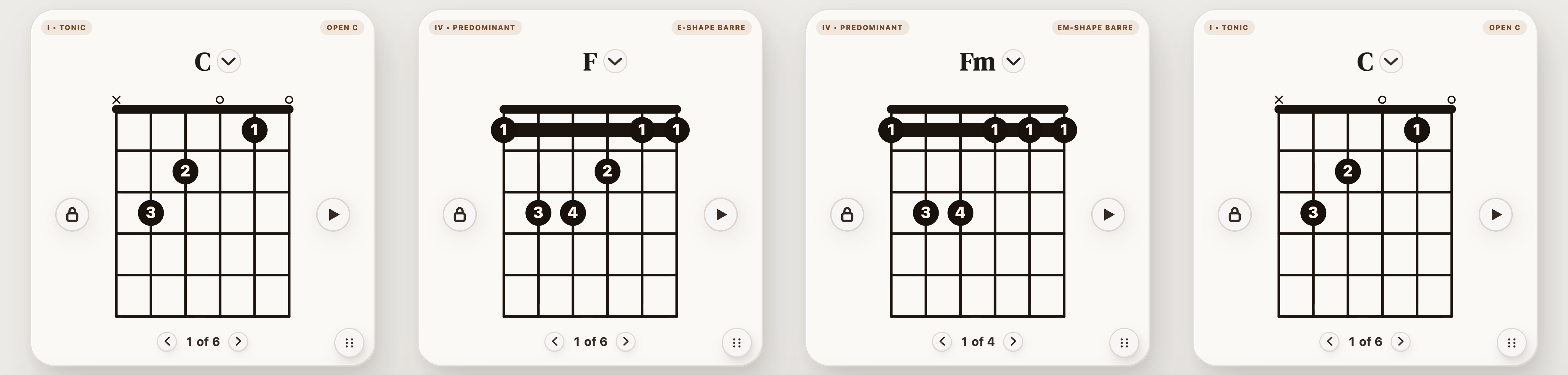
  3. I-iv-IV-I: C, Fm, F, C

    The borrowed minor iv creates a brief sad color before the major IV opens back up.Open in the generator

  4. I-bIII-IV-I: A, C, D, A

    The flat III gives a major-key loop a rougher modal-interchange sound.Open in the generator

  5. i-bVI-IV-i: Am, F, D, Am

    The major IV brightens the minor key with borrowed Dorian color.Open in the generator

  6. I-bVI-bVII-I: E, C, D, E

    Flat-side major chords create a cinematic return to the tonic.Open in the generator

  7. I-iv-I-V: G, Cm, G, D

    Borrowed minor iv softens a major progression without changing the home chord.Open in the generator

  8. I-bIII-bVII-IV: D, F, C, G

    Multiple borrowed chords create a rootsy rock loop around a major tonic.Open in the generator

  9. i-IV-bVI-V: Am, D, F, E

    The borrowed major IV gives a minor progression lift before the dominant returns.Open in the generator

  10. I-bII-IV-I: E, F, A, E

    The flat II is a bright, tense borrowed color that works best when it resolves quickly.Open in the generator

  11. I-bVI-vi-IV: C, Ab, Am, F

    The borrowed flat VI contrasts with the diatonic vi chord.Open in the generator

  12. I-iv-vi-V: D, Gm, Bm, A

    The minor iv gives a major-key loop a direct emotional bend.Open in the generator

Turn the page into a practice session

Use the page as a starting point, then move into the app when you need sound, timing, diagrams, and scale context.

FAQ

Short answers for players using this page as a practice or writing reference.

What is the best way to practice modal interchange on guitar?

Start with one four-chord loop, slow the tempo down, and keep the same voicing family until the rhythm and chord changes feel automatic.

Can I open these examples in StrumForge?

Yes. Each linked example opens a four-chord progression in the generator and counts toward the current 5 free daily progression generations.

Should I change the key?

Yes. Once the loop works, change key or capo position so the idea becomes a fretboard exercise instead of a memorized shape.